Wednesday, March 12, 2008


Princess Henrietta Anne of England (born Henrietta; later Duchess of Orléans; 16 June 1644 – 30 June 1670), in French Henriette d'Angleterre, sometimes known familiarly as Minette, was the youngest daughter of King Charles I of England and Henrietta Maria of France. The Jacobite claims to the throne following the death of Henry Benedict Stuart descend from her.

Duchesse d'Orléans
Louis XIV was very close to his sister-in-law. In fact it was believed at the time that Louis was the real father of Henrietta's two daughters. Louis' mourning of her after her tragic death was even greater than that of Philippe, her husband, lending credence to that theory. However, Philippe was extremely jealous of his wife, possibly abusive, and paraded a succession of male lovers before her.
All of Louis XIV's mistresses (Louise de la Valliere and Athenais de Montespan) were originally ladies-in-waiting to the household of Henrietta. In fact Henrietta encouraged the king's dalliance with Louise to silence the gossip about her and Louis.

Louis XIV
Today, she is best known through her correspondence with her brother King Charles II of England, with whom she was very close. With her brother, she helped to negotiate the Secret Treaty of Dover (1670), which was an offensive and defensive alliance between England and France.
She died at the Palace of Saint-Cloud, near Paris on 30 June 1670, just two weeks after the treaty was signed. At the time of her death, it was widely believed that Henrietta-Anne had been poisoned by friends of her husband's jealous lover and exiled favourite, the Chevalier de Lorraine. An autopsy was performed, however, and it was reported that Henrietta-Anne had died of peritonitis caused by a perforated ulcer.

Henrietta Anne Stuart Later life

Issue

Tuesday, March 11, 2008

Aulus Cornelius Celsus
Aulus Cornelius Celsus (25 BC—50) was a Roman encyclopedist and possibly, although probably not, a physician. He probably lived in Gallia Narbonensis. His only extant work, the De Medicina, is the only surviving section of a much larger encyclopedia, and is a primary source on diet, pharmacy and surgery and related fields. The lost portions of his encyclopedia likely included volumes on agriculture, law, rhetoric, and military arts. Celsus' De Medicina is one of the best sources on Alexandrian medical knowledge.
In the "Prooemium" or introduction to "De Medicina" there is an early discussion of the relevance of theory to medical practice and the pros and cons of both animal experimentation and human experimentation.
Celsus is credited with recording the cardinal signs of inflammation: calor (warmth), dolor (pain), tumor (swelling) and rubor (redness and hyperaemia). He goes into great detail regarding the preparation of numerous ancient medicinal remedies including the preparation of opioids. In addition, he describes many 1st century Roman surgical procedures which included removal of a cataract, treatment for bladder stones, and the setting of fractures.
Celsus' work was rediscovered by Pope Nicholas V and published in 1478. His work became famous for its elegant Latin style.

Monday, March 10, 2008

Early life
After hearing of Saint Anthony, whose name "was in the mouth of all the races of Egypt" (Jerome), at the age of fifteen, he went to live with him in the desert for two months. As Anthony's hermitage was busy with visitors seeking cures for diseases or demonic affliction, he went home together with some monks. At Thabatha, his parents having died in the meantime, he gave his inheritance to his brothers and the poor and left for the wilderness.

Beginnings of Monastic Life
Hilarius went to the area southwest of Majoma, the port of Gaza, that was limited by the sea at one side and marshland on the other. It was the abode of robbers. With him he took only a shirt of coarse linen, a cloak of skins given to him by St. Anthony and a coarse blanket. He led a nomadic life, subsisting only on dried figs, eaten after sunset.
After he was beset by carnal thoughts, he reduced his diet to the juice of herbs and less figs. Cold showers not being available, he took to praying, singing, the hoeing of the soil and the production of baskets made from rushes. Although he was quite starved, "so wasted that his bones scarcely held together" (Jerome) he still had visions of naked women, voluptuous meals, chariots and gladiatorial contests. Often he heard voices, of infants or of domestic animals, which he identified as demons.
He finally built a hut of reeds and sedges, in which he lived for four years. Afterwards, he constructed a tiny low ceilinged cell, "a tomb rather than a house", where he slept on a bed of rushes, recited the bible or sang hymns.
He never washed his clothes, changed them only when they fell apart and shaved his hair only once a year. He was once visited by robbers, but they left him alone when they learned that he did not fear death (and had nothing worth stealing, anyway), promising to mend their ways.
Jerome gives a detailed account of his diet:
After that, he suffered from signs of malnutrition, his eye-sight grew poor, his body shrivelled and he developed dry mange and scabs, so he had to slightly modify his diet.
After he had lived in the wilderness for 22 years, he became quite famous in Palestine. Visitors started to come, begging for his help.

from 20-23: half a pint of lentils moistened with cold water
23-27: dry bread with salt and water
27-30: wild herbs and roots
31-35: six ounces of barley bread, and boiled vegetables without oil
35-63: six ounces of barley bread, and boiled vegetables with oil
63-80: six ounces of water, boiled vegetables with oil and a broth made from flour and crushed herbs, taken after sunset His Time at Majoma
His first miracle was when he cured a woman from Eleutheropolis who had been barren for 15 years. Later, he cured blindness, raised children from the dead, healed a paralysed charioteer, expelled demons. He even cured horses affected by evil magic and tamed a mad Bactrian Camel.

Zeballos, British ColumbiaHilarion Miracles
In time, a monastery grew around his cell, which was so beset by visitors, especially females, that Hilarion fled.
After numerous adventures, always beset by enthusiastic visitors seeking his help, Hilarion died in Cyprus in 371 AD.

Sources
Hermann Hesse adapted a biography of St. Hilarion as one of the three Lives of Joseph Knecht', making up his Nobel Prize winning novel The Glass Bead Game (also known as Magister Ludi).

Sunday, March 9, 2008


Charles Wesley (18 December 1707 - 29 March 1788) was a leader of the Methodist movement, the younger brother of John Wesley. Despite their closeness, Charles and his brother did not always agree on questions relating to their beliefs. In particular, Charles was strongly opposed to the idea of a breach with the Church of England into which they had been ordained. Charles Wesley is chiefly remembered for the many hymns he wrote.

Charles Wesley Best-known hymns
He is commemorated in the Calendar of Saints of the Evangelical Lutheran Church in America on March 2 with his brother John.
As a result of his enduring hymnody, the Gospel Music Association recognized his musical contributions to the art of gospel music in 1995 by listing his name in the Gospel Music Hall of Fame.

Saturday, March 8, 2008

Gellu Naum
Gellu Naum (August 1, 1915-September 29, 2001) was a prominent Romanian poet, dramatist, novelist, children's writer, and translator. He is remembered as the founder of the Romanian Surrealist group. The artist Lyggia Naum, his wife, was the inspiration and main character in his 1985 novel Zenobia.

Biography

Drumeţul incendiar ("The Incendiary Traveler"; poems, illustrated by Victor Brauner), Bucharest, 1936
Vasco de Gama, (poems, illustrated by Jacques Hérold), Bucharest, 1940
Culoarul somnului, ("The Corridor of Sleep"; poems, illustrated by Victor Brauner), Bucharest, 1944
Medium (prose), Bucharest, 1945
Critica mizeriei ("Critique of Misery"; manifesto, co-written with Paul Păun and Virgil Teodorescu), Bucharest, 1945
Teribilul interzis ("The Terrible Forbidden"; drama, illustrated by Paul Păun), Bucharest, 1945
Spectrul longevităţii: 122 de cadavre ("The Specter of Longevity: 122 corpses"; drama, co-written with Virgil Teodorescu), Bucharest, 1946
Castelul Orbilor ("Castle of the Blind"; drama), Bucharest, 1946
L'infra-noir ("Infra-Black"; manifesto, co-written with Gherasim Luca, Paul Păun, Virgil Teodorescu, and Dolfi Trost), Bucharest, 1947
Éloge de Malombra - Cerne de l'amour absolu ("Malombra's Eulogy - Black Circle of Absolute Love"; manifesto, co-written with Gherasim Luca, Paul Păun, and Dolfi Trost), Bucharest, 1947
Athanor (poems), Bucharest, 1968
Poetizaţi, poetizaţi... ("Poeticize, Poeticize..."; prose), Bucharest, 1970
Copacul-animal ("The Animal-Tree"; poems), Bucharest, 1971
Tatăl meu obosit ("My Tired Father"; poems), Bucharest, 1972
Poeme alese ("Selected Poems"; poems), Bucharest, 1974
Cărţile cu Apolodor ("The Apolodor Books", poems for children), Bucharest, 1975
Descrierea turnului ("Description of the Tower"; poems), Bucharest, 1975
Insula. Ceasornicăria Taus. Poate Eleonora ("The Island. The Taus Clockmakers. Eleonora, Perhaps"; drama), Bucharest, 1979
Partea cealaltă ("The Other Side"; poems), Bucharest, 1980
Zenobia (novel), Bucharest, 1985
Malul albastru ("The Blue Shore; prose), Bucharest, 1990
Faţa şi suprafaţa, urmat de Malul albastru ("Face and Surface, followed by The Blue Shore", poems), Bucharest, 1994
Focul negru ("Black Fire"; poems), Bucharest, 1995
Sora fântână ("Sister Fountain"; poems), Bucharest, 1995
Întrebătorul ("The Inquirer"; prose), Bucharest, 1996
Copacul-animal, urmat de Avantajul vertebrelor ("The Animal-Tree, followed by The Advantage of Vertebrae"), Cluj-Napoca, 2000
Ascet la baraca de tir ("Recluse in the Firing Range Shack"; poems), Bucharest, 2000

Friday, March 7, 2008

Evan Thomas
Evan Thomas (born April 1951) is an American journalist and author.
A graduate of Phillips Andover, Harvard University and the University of Virginia School of Law, since 1991 he has been the Assistant Managing Editor at Newsweek. From 1986-1996, he was Newsweek's Washington bureau chief. He has won numerous journalism awards, including a National Magazine Award in 1998 for NEWSWEEK's coverage of the Monica Lewinsky scandal.
He is the grandson of the late Norman Thomas, a six-time Presidential candidate for the Socialist Party of America. He is married to Osceola Freear and is the father of two daughters, Louisa Herron Thomas and Mary Osceola Thomas. They live in Washington D.C.
On April 9, 2007, Thomas was a guest on the Donald Imus show in the midst of a developing controversy arising from a statement by Imus regarding players on the Rutgers women's basketball team. "He should not have said what he said, obviously," Thomas told the New York Times. "I am going on the show, though. I think if I didn't, it would be posturing. I have been going on the show for quite some time and he occasionally goes over the line."

Thursday, March 6, 2008


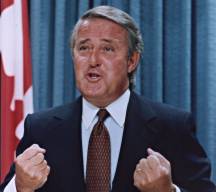
The Meech Lake Accord was a set of failed amendments to the Constitution of Canada negotiated in 1987 by Prime Minister Brian Mulroney and the provincial premiers, including Robert Bourassa, premier of Quebec. It was designed to persuade Quebec to endorse the Canada Act.

Meech Lake Accord Prelude
The accord was negotiated at a meeting between Mulroney and provincial premiers at Willson House at Meech Lake in the Gatineau Hills in 1987.

a recognition of the province of Quebec as a "distinct society"
a constitutional veto for Quebec
increased provincial powers with respect to immigration
extension and regulation of the right for a reasonable financial compensation to any province that chooses to opt out of any future federal programs
provincial input in appointing senators and Supreme Court judges Opposition
As the deadline approached, however, the consensus began to unravel. Pressure from voters at home brought many premiers, especially those in the Western provinces, under fire. The Accord became an issue in some provincial elections, as New Brunswick elected the Liberal government of Frank McKenna, which revoked the previous government's approval of the Accord. Newfoundland Premier Clyde Wells would soon do likewise.
With a matter of months before the Accord deadline, a commission led by prominent Tory Jean Charest recommended some changes to the Accord. This prompted Lucien Bouchard, environment minister, and also chief Quebec lieutenant, under Mulroney, and others to leave the Progressive Conservatives. Eventually, they, and several disenchanted Liberals formed the federal Bloc Québécois party.
Arguably, the most pressure was on Quebec Premier, Robert Bourassa. To many Quebecers, the Accord was the bare minimum acceptable. Any weakening of the Accord would undermine Bourassa's position and possibly bring a large backlash from Quebec.
This prompted a first ministers conference on June 3, 1990 (20 days before the deadline of the Accord). After a week of negotiations, an agreement for further rounds of constitutional negotiations was devised to follow ratification of Meech Lake. All 10 premiers again signed the "new" Accord, although Wells said that he would have to consult with the people of Newfoundland before committing to the Accord.
The agreement promised:
During the meeting, Wells echoed the feelings of many in the country:
New Brunswick soon accepted the Accord, and Frank McKenna toured the nation to drum up support.
In Manitoba, however, things did not go as planned. With many First Nations protesters outside, the Legislative assembly convened to approve the Accord. Unanimous support was needed to bypass the necessary public consultation, and MLA Elijah Harper raised an eagle feather to mark his dissension. Harper opposed bypassing consultation because he did not believe First Nations had been adequately involved in the Accord's process.
Even though a legal route was found to give Manitoba more time (the deadline would be extended three months, with Quebec being able to re-approve the Accord), Clyde Wells and Opposition leader Thomas Rideout agreed to cancel the planned free vote in the Newfoundland House of Assembly, because the outcome would have most likely been a refusal. The Accord was officially dead.

A commitment to Senate reform by July 1, 1995. The proposed Senate would be elected, "effective" (having power over most bills), and be more representative of the other provinces. If a unanimous agreement was not made, the Senate would convert to Quebec having 24 seats, Ontario having 18, Prince Edward Island with 4, and all other provinces with 8 seats.
A guarantee to not weaken gender equality.
To give the Territories the power to nominate Senators and Supreme Court justices.
Future conferences on Aboriginal and minority language issues.
Later discussions on a "Canada Clause", how new provinces would be formed, and a new amending procedure. Aftermath

Le Mouton noir (documentary film)
Distinct society